
1. What Is the Difference Between Red and Green Laser Levels?
The primary difference between a red laser level and a green laser level is the wavelength of the laser beam.
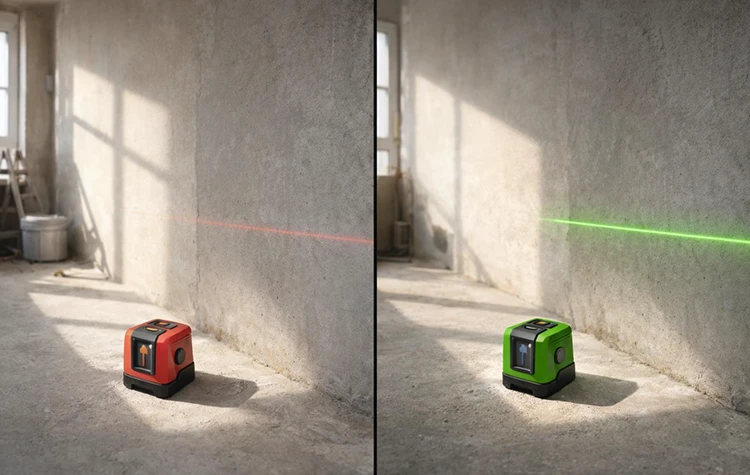
A typical red laser level operates at approximately 635–650 nm, while a green laser level commonly operates around 515–532 nm, depending on the laser diode technology.
The human eye is more sensitive to green light under normal daylight conditions. As a result, green laser lines generally appear brighter and are easier to identify than red laser lines under similar conditions.
This difference makes green laser levels particularly attractive for professional indoor construction and installation projects.
However, beam color does not automatically determine measurement accuracy. The accuracy of a laser level depends more on its optical system, laser module quality, calibration, and self-leveling mechanism.
For B2B buyers, understanding this distinction helps avoid choosing a product based solely on its beam color.
2. Red Laser Level vs. Green Laser Level: Key Differences
When comparing different laser level models, buyers should evaluate more than just brightness. The following factors directly influence product performance, operating costs, and customer satisfaction.
Beam Visibility
A green laser level generally offers better visibility than a red laser level, especially in well-lit indoor environments.
This is particularly useful for:
- Large construction interiors
- Ceiling installation
- Wall partition alignment
- Tile and flooring installation
- Cabinet and furniture positioning
A red laser level remains suitable for standard indoor applications, particularly in smaller spaces or environments with controlled lighting.
Battery Consumption
Power efficiency is another important consideration when selecting a laser level.
In many comparable product configurations, green laser modules consume more power than red laser modules. This can result in shorter operating times when battery capacity and other conditions are similar.
For professional users who need continuous operation throughout the working day, battery capacity, charging speed, and power management should all be evaluated.
Manufacturers can improve the user experience by optimizing the laser module, circuit design, and rechargeable battery system.
Purchase Cost
A green laser level typically has a higher production cost due to its laser module and associated optical technology.
A red laser level is often a more economical option for entry-level markets, general-purpose applications, and price-sensitive customers.
For wholesalers and distributors, offering both options can help cover multiple market segments without relying on a single product configuration.
Working Distance and Outdoor Applications
The visible working distance of a laser level depends on several factors, including beam output, ambient lighting, surface reflectivity, and environmental conditions.
Green beams are generally easier to see indoors over longer distances. However, neither a red nor a green laser level should be assumed to remain clearly visible under direct sunlight.
For outdoor construction, buyers should prioritize models with a compatible laser receiver or detector and verify the manufacturer's specified operating range.
A receiver-compatible laser level can provide more reliable positioning over longer distances, even when the projected line is difficult to see with the naked eye.
3. Comparison Table: Red Laser Level vs. Green Laser Level
| Comparison Factor | Red Laser Level | Green Laesr Level |
|---|---|---|
| Beam visibility | Standard | Higher perceived visibility |
| Indoor applications | Excellent for general tasks | Excellent for well-lit and larger spaces |
| Battery efficiency | Generally better | Generally higher power consumption |
| Manufacturing cost | Usually lower | Usually higher |
| Outdoor operation | Receiver recommended | Receiver recommended |
| Entry-level markets | Highly suitable | Suitable depending on budget |
| Professional applications | Suitable | Particularly useful for visibility-demanding work |
The best laser level depends on the intended application, customer expectations, and target market. Green is not always better, and red is not necessarily less accurate.
4. How to Choose the Right Laser Level for Different Applications
Selecting a suitable laser level requires understanding the actual working environment and the type of alignment tasks involved.
Construction and Renovation
For general construction and renovation, a self-leveling laser level can help workers establish consistent horizontal and vertical references.
Common applications include:
- Wall framing and partition installation
- Floor leveling and tile installation
- Ceiling grid positioning
- Door and window alignment
- Electrical and plumbing installation
A green laser level is a practical choice for larger indoor environments where beam visibility is important.
Interior Decoration and Cabinet Installation
Interior finishing requires accurate alignment and clearly visible reference lines.
A cross-line laser level is suitable for basic horizontal and vertical alignment, while a 360-degree laser level provides more comprehensive coverage for room layouts.
For example, a 3×360 laser level can project horizontal and vertical reference planes around an entire room, reducing the need to reposition the instrument repeatedly.
Large-Scale Construction Projects
For projects involving multiple walls, ceiling structures, and installation areas, a multi-line laser level can improve workflow efficiency.
A 3D or 4D laser level offers multiple projection planes for more flexible positioning and layout work.
When working outdoors or over extended distances, compatibility with a laser receiver becomes an important purchasing consideration.
5. Beyond Beam Color: Five Important Laser Level Specifications
For importers, distributors, and private-label brands, evaluating the technical specifications of a laser level is essential before placing bulk orders.
1. Measurement Accuracy
Accuracy is one of the most important specifications of any laser level.
Manufacturers generally express accuracy as a measurement deviation over a specified distance, such as ±1 mm/5 m.
Buyers should compare accuracy specifications under the same measurement conditions and request calibration or inspection documentation when necessary.
2. Self-Leveling Range
A self-leveling laser level uses an internal compensator mechanism to automatically establish horizontal and vertical reference lines within a specified tilt range.
Common specifications include ±3° or ±4°, depending on the model.
Buyers should also check whether the instrument provides a flashing or audible warning when it exceeds its self-leveling range.
3. Laser Line Coverage
Different laser level configurations are designed for different applications.
Cross-line laser level: Projects horizontal and vertical lines.
3D laser level: Commonly projects three 360-degree laser planes.
4D laser level: Commonly provides four 360-degree laser planes.
Rotary laser level: Projects a rotating reference plane for larger construction areas.
The correct configuration depends on the installation environment and the needs of the end user.
4. Battery Capacity and Operating Time
Battery performance directly affects productivity on construction sites.
A professional laser level should provide a suitable balance between battery capacity, charging time, continuous operating time, and overall product weight.
Rechargeable lithium battery systems and USB-C charging are useful features for many modern construction tools.
5. Protection and Durability
Construction environments often involve dust, vibration, accidental impacts, and moisture.
When evaluating a laser level, buyers should check:
- Housing material and structural strength
- Lens protection
- Dust and water resistance ratings
- Pendulum locking mechanism
- Operating temperature range
- Drop-resistance test conditions
These specifications can influence product lifespan, after-sales costs, and customer satisfaction.
6. Why Work with VCHON for Laser Level Sourcing?
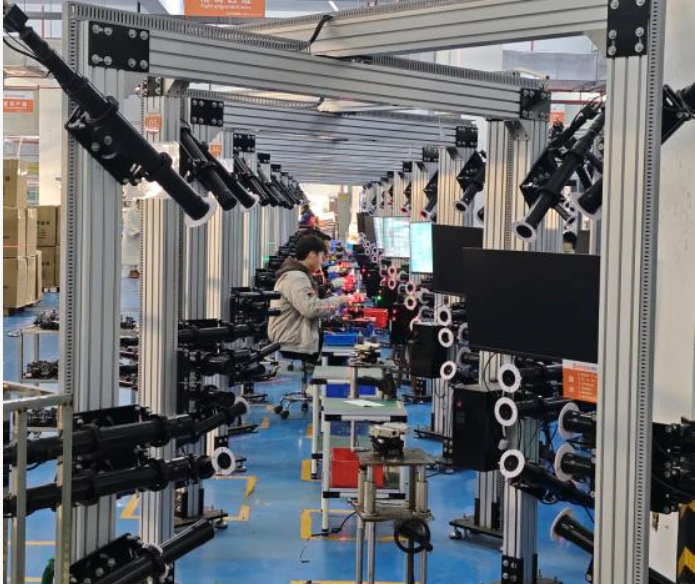
VCHON Electronics specializes in precision tools and intelligent electronic products, including professional laser levels for construction, renovation, and installation applications.
With manufacturing experience, integrated R&D capabilities, and OEM/ODM services, VCHON supports international distributors, importers, wholesalers, and private-label brands.
Our laser level product range includes:
- 3×360 Laser Level
- Professional 3D/4D Laser Level
- Self-Leveling Laser Level
- 16-Line Laser Level
- Green Laser Level
- Laser Level Accessories
We focus on helping business partners develop suitable product configurations for their target markets.
Our cooperation capabilities include product customization, manufacturing support, quality control, and supply solutions for different business requirements.
Whether you are developing a new construction tool brand or expanding your existing product portfolio, choosing the right laser level supplier can help strengthen your market competitiveness.
Looking for a Reliable Laser Level Manufacturer?
Contact VCHON to discuss your OEM/ODM requirements, wholesale orders, product specifications, and customized laser level solutions.
Visit our Laser Level Product Collection to explore available models.


